⚠️ Shocking Truth: The average Shopify store has 6-10 apps installed. Each one adds 0.3-2 seconds to load time. That’s why stores with too many apps convert 40% worse than streamlined stores—and why we often build custom solutions instead.
🚀 Need immediate help? Get expert optimization from certified Shopify professionals who’ve helped hundreds of stores eliminate app bloat and boost conversions.
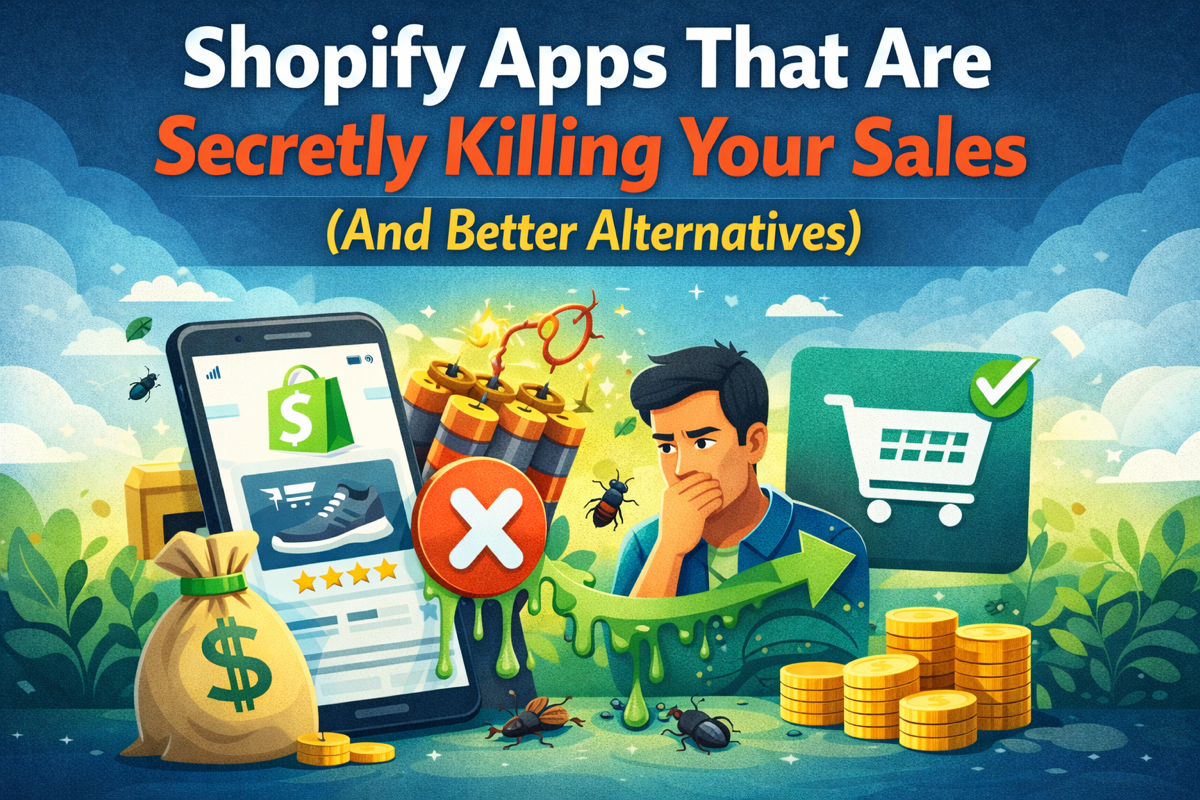
Think your apps are helping your store? Think again. After auditing hundreds of Shopify stores as certified Shopify Experts, we’ve discovered a shocking pattern: the very apps merchants install to boost sales are often the biggest culprits behind lost revenue. Every second of added load time can decrease conversions by up to 7%, yet most store owners have no idea which apps are silently sabotaging their success.
The Hidden Cost of App Overload
When you first launch your Shopify store, the app marketplace feels like a candy store. There’s a solution for everything: pop-ups, reviews, wishlists, loyalty programs, chat widgets, and countless other features promising to skyrocket your sales. But here’s what app developers won’t tell you: every single app you install comes with a performance tax that compounds exponentially.
📊 Reality Check: Stores with 3-5 carefully selected apps maintain average load times of 2.8 seconds. Stores with 10+ apps? They’re crawling at 6.2 seconds or slower.
Consider this reality check from our recent client audit data. Given that 53% of mobile visitors abandon sites that take longer than 3 seconds to load, those extra apps aren’t adding features—they’re adding friction that drives customers away.
The problem extends beyond just speed. Each app injects its own JavaScript, CSS, and tracking scripts into your store. These scripts often conflict with each other, creating visual glitches, checkout errors, and unpredictable behavior that frustrates customers and destroys trust. We’ve seen stores where competing analytics apps were double-counting conversions, leading to completely inaccurate business decisions.
The Worst Offenders: Apps That Destroy Performance
Not all apps are created equal when it comes to performance impact. Through extensive testing and real-world optimization work, we’ve identified the categories and specific apps that most commonly cause severe performance degradation. Understanding these patterns helps you make informed decisions about which apps truly deserve a place in your store.
Social Proof and Pop-up Apps
Social proof apps promise to boost conversions by showing recent purchases, visitor counts, and creating urgency. While the psychology behind these tactics is sound, the implementation often backfires spectacularly.
Popular apps like Sales Pop and Proof Bear can add 1.5-3 seconds to your load time because they constantly poll your store’s data, load heavy animation libraries, and inject multiple tracking pixels. The aggressive pop-ups often annoy customers more than they convert, especially on mobile devices where they block content and create accidental clicks.
✅ Better Alternative: Instead of using resource-heavy apps, implement lightweight custom notifications using Shopify’s native notification API. A simple JavaScript snippet can display recent purchases without the bloat. For stores that genuinely benefit from social proof, we recommend building a custom solution that loads asynchronously and respects user experience guidelines.
All-in-One Marketing Suites
Comprehensive marketing platforms like Omnisend, Privy, and similar “swiss army knife” apps promise to handle email, SMS, pop-ups, and more from a single dashboard. The convenience is tempting, but these apps are often performance nightmares.
These platforms load massive JavaScript bundles even when you’re only using a fraction of their features. A store using Privy just for email pop-ups still loads code for spin-to-win wheels, banners, cart abandonment, and dozens of other unused features. We’ve measured some of these apps adding up to 800KB of unnecessary code to every page load.
💡 Pro Tip: Choose specialized, lightweight tools for each specific need. The slight inconvenience of managing separate tools is vastly outweighed by the performance benefits.
Better Alternative: Use Klaviyo or Postmark for email (which process server-side), implement exit-intent pop-ups with minimal custom code, and leverage Shopify’s built-in abandoned cart recovery.
⚡ Is your store crawling? Get professional speed optimization and watch your conversions soar. Our experts can cut your load time by 50-70%.
Page Builder Apps
Page builders like PageFly, GemPages, and Shogun promise drag-and-drop simplicity for creating custom layouts. While they deliver on ease of use, they’re among the worst performance offenders in the entire app ecosystem.
These apps generate bloated HTML, inline styles, and redundant code that can triple or quadruple your page weight. A simple landing page that should be 200KB often balloons to 2MB or more. Even worse, the code they generate isn’t optimized for Core Web Vitals, causing layout shifts, slow interaction times, and poor mobile experiences that Google actively penalizes in search rankings.
🛠️ Better Alternative: Work with a developer to create clean, optimized page templates using Shopify’s native section and block system. Custom sections load faster, rank better, and provide a superior user experience that actually converts visitors into customers.
Review and Rating Apps
Customer reviews are essential for building trust, but many review apps are surprisingly resource-intensive. Apps like Judge.me, Yotpo, and Loox often load multiple JavaScript files, custom fonts, and make numerous API calls just to display star ratings.
The worst part? Many of these apps render reviews client-side, meaning search engines can’t properly index your valuable user-generated content. You’re paying a performance penalty without even getting the SEO benefit of review content.
Better Alternative: Shopify’s native Product Reviews app is surprisingly capable and performs well. For stores needing advanced features, consider a hybrid approach: use a lightweight review collection service that exports to native Shopify metafields, then display reviews using theme code.
How to Audit Your Current App Stack
Before you can fix your app problem, you need to understand its scope. Here’s our proven framework for conducting a comprehensive app audit that reveals which apps are worth keeping and which need to go.
Step 1: Measure Your Baseline Performance
Start by documenting your current performance metrics. Use Google PageSpeed Insights to test your homepage, a product page, and your checkout flow. Record your Core Web Vitals scores, particularly Largest Contentful Paint (LCP) and Time to Interactive (TTI). These metrics directly correlate with conversion rates.
Run these tests on both mobile and desktop, as mobile performance is typically worse and increasingly important for conversions. Save screenshots or PDFs of these reports—you’ll want to compare them after making changes.
Step 2: Identify Resource-Heavy Apps
Use Chrome DevTools Network tab to see exactly what each app is loading. Visit your store in an incognito window, open DevTools (F12), go to the Network tab, and refresh the page. Sort by size to see the largest files, then look at the initiator column to identify which app is responsible.
🔍 Look for these red flags:
- JavaScript files over 100KB
- Multiple requests from the same domain
- Third-party tracking pixels
- Fonts and images loaded from external sources
Create a spreadsheet listing each app, its total resource size, number of requests, and approximate load time impact.
Step 3: Evaluate Business Impact vs. Performance Cost
For each app, honestly assess its contribution to your business. Track metrics like how many customers actually use the feature, conversion rate with and without the app, revenue directly attributable to the app, and time saved through automation.
Many store owners are surprised to discover that apps they thought were essential have minimal impact on actual sales. That wishlist app might seem important, but if only 2% of visitors use it while it slows down your site for everyone, it’s not worth keeping.
Step 4: Test Removal Impact
Before permanently removing apps, test the impact using Shopify’s theme duplicate feature. Create a copy of your theme, remove the app from the duplicate, and use Shopify’s preview mode to test performance improvements.
Document the performance gains from removing each app. Often, removing just 2-3 heavy apps can cut load times in half and significantly improve Core Web Vitals scores.
🎯 Want expert help with your app audit?
Our certified Shopify Experts can identify exactly which apps are killing your performance and provide custom alternatives that actually work.
The Smart Approach: Custom Solutions That Actually Work
After helping hundreds of merchants optimize their stores, we’ve learned that the best-performing stores share a common trait: they rely on custom solutions rather than off-the-shelf apps for critical functionality. This doesn’t mean reinventing the wheel—it means implementing exactly what you need, exactly how you need it, without unnecessary bloat.
When Custom Development Makes Sense
Custom development becomes cost-effective when you’re losing more money to poor performance than you’d spend on development. For most stores doing over $10,000 per month, custom solutions pay for themselves within 2-3 months through improved conversion rates alone.
Consider custom solutions for:
- Features used on every page (like currency converters or announcement bars)
- Checkout modifications and upsells
- Product customization tools
- Inventory management integrations
- Complex pricing or discount logic
The key is building modular, maintainable code that can evolve with your business. A well-architected custom solution often outlasts multiple app alternatives and provides a competitive advantage through superior user experience.
Real Client Success Story
📈 Case Study: Fashion Accessories Store Transformation
The Problem: Store was painfully slow with 5 heavy apps adding 2MB of code
Our Solution: Replaced all apps with 45KB of custom code
Results:
- Page load time: 6.8s → 2.3s (66% faster)
- Mobile conversion rate: 0.8% → 2.4% (3x improvement)
- Revenue increase: 67% within 60 days
- ROI achieved in just 3 weeks
The custom development investment paid for itself through increased conversions, and the store now has a sustainable competitive advantage through superior performance.
Essential Apps Worth Keeping
Not all apps deserve condemnation. Some provide genuine value that justifies their performance cost. Here are the categories of apps we consistently recommend keeping, along with specific recommendations for each.
Email Marketing Platforms
Email remains the highest ROI marketing channel, and dedicated email platforms are worth their weight. Klaviyo and Postmark operate primarily server-side, meaning they don’t slow down your store’s frontend. They provide sophisticated segmentation, automation, and analytics that would be expensive to replicate.
Choose email apps that process data server-side, only load minimal JavaScript for forms, integrate directly with Shopify’s customer API, and provide clear ROI through detailed analytics.
Inventory Management Systems
For stores with complex inventory needs, apps like Stocky or inFlow provide essential functionality that’s deeply integrated with your operations. These apps typically run in the background without affecting store performance, making them ideal for scaling businesses.
Customer Service Tools
Gorgias and similar customer service platforms are invaluable for managing customer communications at scale. They load asynchronously and provide features like macro responses, order lookups, and team collaboration that significantly improve response times and customer satisfaction.
Analytics and Attribution
While Google Analytics is essential, additional attribution tools like Triple Whale or Northbeam provide insights that directly impact profitability. These tools help you understand true customer acquisition costs and lifetime values across channels. Choose analytics apps that use server-side tracking whenever possible.
🔍 Need better insights? Improve your SEO and tracking with expert optimization that drives organic traffic and improves data accuracy.
Optimization Strategies for Apps You Must Keep
Sometimes you can’t avoid using certain apps, whether due to business requirements or technical limitations. In these cases, optimization becomes crucial. Here are advanced strategies for minimizing the performance impact of essential apps.
Lazy Loading and Conditional Loading
Configure apps to load only when needed. For example, chat widgets should only load after a user has been on the page for 10+ seconds or scrolled past a certain point. Review apps should load only on product pages, not on the homepage or collection pages.
Use Shopify’s Script Tag API to control exactly when and where app resources load. This single optimization can reduce initial page load by 30-50% for app-heavy stores.
Asynchronous Loading Patterns
Ensure all app JavaScript loads asynchronously using the `async` or `defer` attributes. This prevents apps from blocking the main thread and allows your core content to load first. Many apps don’t implement this by default, but you can modify their script tags in your theme code.
Resource Hints and Preloading
For apps that must load immediately, use resource hints like `dns-prefetch` and `preconnect` to establish early connections to third-party domains. This reduces latency when the resources are actually requested.
Regular App Hygiene
Set a monthly reminder to review your installed apps. Remove any apps you haven’t used in the past 30 days. Uninstalled apps often leave behind code snippets in your theme—manually remove these remnants to ensure complete cleanup.
The Strategic Approach to App Selection
Moving forward, adopt a strategic framework for evaluating new apps before installation. This proactive approach prevents performance degradation and maintains optimal store speed.
The 5-Point App Evaluation Framework
Before installing any app, evaluate:
- Performance Impact: Test the app on a development store and measure load time changes
- Feature Necessity: Determine if the feature directly impacts revenue or customer satisfaction
- Native Alternatives: Check if Shopify offers native functionality that could replace the app
- Integration Quality: Review how well the app integrates with your theme and other tools
- Long-term Value: Consider whether you’ll still need this functionality in 6-12 months
If an app doesn’t score highly on all five criteria, reconsider whether you really need it.
Building a Lean Tech Stack
The most successful Shopify stores we work with maintain lean tech stacks focused on core functionality. They typically use one email marketing platform, one analytics solution, one customer service tool, one inventory management system (if needed), and custom code for everything else.
This approach maintains blazing-fast performance while providing all necessary functionality for scaling operations.
📊 Ready to optimize your conversion rates?
Stop losing sales to slow apps and poor user experience. Our conversion rate optimization experts can help you identify and fix the issues killing your conversions.
Taking Action: Your Next Steps
Now that you understand how apps impact your store’s performance and revenue, it’s time to take action. Here’s your roadmap for the next 30 days:
📅 Your 30-Day Action Plan
Week 1: Conduct your app audit using our framework. Document current performance metrics and identify problem apps.
Week 2: Remove or replace the worst performers. Start with apps that provide minimal value or have native Shopify alternatives.
Week 3: Optimize remaining essential apps using lazy loading and async patterns. Clean up residual code from uninstalled apps.
Week 4: Measure improvements and calculate ROI. Compare your new metrics to your baseline and calculate the revenue impact of improved conversion rates.
Remember, every second you shave off your load time directly impacts your bottom line. The stores that win in 2025 and beyond will be those that prioritize performance and user experience over feature bloat.
Expert Help for Maximum Results
While this guide provides a comprehensive framework for app optimization, implementing these strategies effectively requires technical expertise and experience. That’s where professional optimization makes the difference between marginal improvements and transformative results.
Our team of certified Shopify Experts specializes in app audits, custom development, and performance optimization. We’ve helped hundreds of merchants reduce load times by 50-70% while maintaining or enhancing functionality through smart custom solutions.
🚀 Stop Letting Apps Kill Your Sales
Get a professional audit that identifies exactly which apps are hurting your performance and receive a customized optimization roadmap for your specific needs.
Frequently Asked Questions
How many Shopify apps is too many?
Most successful stores operate efficiently with 3-5 carefully selected apps. Stores with 10+ apps typically experience significant performance issues that hurt conversions. Focus on quality over quantity—each app should directly contribute to revenue or essential operations.
Which Shopify apps slow down stores the most?
Page builders, pop-up apps, all-in-one marketing suites, and social proof apps are typically the worst performance offenders, often adding 2-3 seconds to load times. Review apps and chat widgets can also significantly impact performance if not properly optimized.
How do slow Shopify apps affect sales?
Every second of added load time can decrease conversions by 7%. Apps that slow your store by 3-4 seconds can reduce sales by 20-30% or more. Mobile users are particularly sensitive to slow load times, with 53% abandoning sites that take over 3 seconds to load.
Can I improve app performance without removing them?
Yes, through lazy loading, asynchronous loading, and conditional loading strategies. However, some apps are inherently heavy and can’t be fully optimized. Professional developers can often achieve 30-50% improvements through optimization alone.
How much does custom development cost compared to apps?
While custom development has higher upfront costs, it typically pays for itself within 2-3 months through improved conversion rates. Most app subscriptions cost $20-200/month indefinitely, while custom solutions are a one-time investment that provides permanent performance benefits.
Conclusion: Less Is More for Shopify Success
The path to a high-converting Shopify store isn’t through adding more apps—it’s through strategic subtraction and smart custom solutions. Every unnecessary app you remove is a step toward better performance, higher conversions, and increased profitability.
Focus on building a lean, optimized store that loads quickly and provides an exceptional user experience. When you do need additional functionality, consider custom development that’s tailored to your specific needs rather than generic apps that bloat your store.
The most successful Shopify merchants understand that performance is a feature—perhaps the most important feature of all. By taking control of your app stack and prioritizing speed, you’re not just improving metrics; you’re building a sustainable competitive advantage that compounds over time.
Your customers don’t care about how many features your store has. They care about finding what they want quickly and checking out without friction. Give them that experience, and watch your sales soar.
Ready to Eliminate App Bloat and Boost Your Sales?
Join hundreds of successful merchants who’ve transformed their stores with expert optimization.